" width="115px"><path d="M 0 11.096 L 0 0 L 115 0 L 115 11.096 Z" fill="transparent" height="11.096491228070176px" id="GfQnkLdoY" width="115px"/><path d="M 1.941 0 L 0 0 L 0.045 10.747 L 1.941 10.747 L 1.941 5.941 L 7.314 5.941 L 7.314 10.747 L 9.301 10.747 L 9.301 0 L 7.314 0 L 7.314 4.194 L 1.941 4.194 Z" fill="rgb(255, 255, 255)" height="10.747026605263157px" id="xZ90Edlp4" transform="translate(9.617 0.087)" width="9.300978070175441px"/><path d="M 0 0 L 0 1.747 L 3.07 1.747 L 3.07 10.747 L 4.967 10.747 L 4.967 1.747 L 8.037 1.747 L 8.037 0 Z" fill="rgb(255, 255, 255)" height="10.747026605263157px" id="eLoRGqE05" transform="translate(0 0.087)" width="8.036805263157738px"/><path d="M 0 0 L 0 1.747 L 3.07 1.747 L 3.07 10.747 L 4.966 10.747 L 4.966 1.747 L 8.037 1.747 L 8.037 0 Z" fill="rgb(255, 255, 255)" height="10.747026605263157px" id="H1i1R1ROm" transform="translate(90.211 0.087)" width="8.036785087719196px"/><path d="M 0 0 L 0 1.747 L 3.07 1.747 L 3.07 10.747 L 4.966 10.747 L 4.966 1.747 L 8.037 1.747 L 8.037 0 Z" fill="rgb(255, 255, 255)" height="10.747026605263157px" id="Qciook51k" transform="translate(98.79 0.087)" width="8.03718859649102px"/><path d="M 0 0 L 7.089 0 L 7.089 1.704 L 2.032 1.704 L 2.032 4.325 L 6.727 4.325 L 6.727 6.072 L 2.032 6.072 L 2.032 9.043 L 7.179 9.043 L 7.179 10.747 L 0 10.747 Z" fill="rgb(255, 255, 255)" height="10.747026605263157px" id="MoRysDMkT" transform="translate(21.401 0.087)" width="7.179026315789308px"/><path d="M 0 0 L 1.987 0 L 1.987 5.155 L 6.682 0 L 9.075 0 L 1.987 7.645 L 1.987 10.791 L 0 10.791 Z" fill="rgb(255, 255, 255)" height="10.79070642982456px" id="Fk7Bn8sbD" transform="translate(32.192 0.087)" width="9.075315789473677px"/><path d="M 2.935 5.286 L 0 1.354 L 1.264 0 L 5.237 5.286 Z" fill="rgb(255, 255, 255)" height="5.2861565789473675px" id="UnCC38I0J" transform="translate(36.075 5.548)" width="5.237442982455946px"/><path d="M 1.987 0 L 0 0 L 0 10.747 L 1.987 10.747 Z" fill="rgb(255, 255, 255)" height="10.747026605263157px" id="lzTmOx_0g" transform="translate(42.848 0.087)" width="1.9865745614037138px"/><path d="M 1.987 0 L 0 0 L 0 10.747 L 1.987 10.747 L 6.366 10.747 L 6.366 9.043 L 1.987 9.043 Z" fill="rgb(255, 255, 255)" height="10.747026605263157px" id="TF90CbuD0" transform="translate(47.408 0.087)" width="6.366258771929772px"/><path d="M 1.941 0 L 0 0 L 3.341 10.747 L 4.921 10.747 L 7.269 3.67 L 9.572 10.747 L 11.197 10.747 L 14.539 0 L 12.597 0 L 10.249 7.121 L 7.946 0 L 6.547 0 L 4.199 7.121 Z" fill="rgb(255, 255, 255)" height="10.747026605263157px" id="t78dLE21a" transform="translate(66.507 0.087)" width="14.538521929824569px"/><path d="M 4.605 0 L 6.592 0 L 2.077 10.747 L 0 10.747 Z" fill="rgb(255, 255, 255)" height="10.747026605263157px" id="PM3SalCzg" transform="translate(80.007 0.087)" width="6.592021929824725px"/><path d="M 0 2.272 L 0.993 0 L 5.012 9.218 L 2.89 9.218 Z" fill="rgb(255, 255, 255)" height="9.217986403508773px" id="Cx__VM8gT" transform="translate(85.967 1.616)" width="5.011679824561455px"/><path d="M 5.915 0 C 9.181 0 11.829 2.484 11.829 5.548 C 11.829 8.612 9.181 11.096 5.915 11.096 C 2.648 11.096 0 8.612 0 5.548 C 0 2.484 2.648 0 5.915 0 Z M 5.915 1.66 C 3.645 1.66 1.806 3.401 1.806 5.548 C 1.806 7.696 3.645 9.437 5.915 9.437 C 8.184 9.437 10.024 7.696 10.024 5.548 C 10.024 3.401 8.184 1.66 5.915 1.66 Z" fill="rgb(255, 255, 255)" height="11.096491228070176px" id="hxVDWSLWw" transform="translate(54.361 0)" width="11.829364035087934px"/><path d="M 0 8.519 L 1.446 7.602 C 1.701 8.155 2.601 9.262 4.154 9.262 C 4.802 9.276 6.096 8.965 6.096 7.602 C 6.096 6.946 5.373 6.597 2.573 5.461 C 0.334 4.552 0.632 2.461 1.039 1.485 C 1.384 0.655 2.239 0 4.154 0 C 6.069 0 7.149 1.107 7.45 1.66 L 6.096 2.578 C 5.9 2.272 5.238 1.66 4.154 1.66 C 3.071 1.66 2.619 2.141 2.619 2.665 C 2.619 3.888 3.974 4.15 6.005 4.98 C 7.63 5.644 8.067 7.004 8.037 7.602 C 8.037 8.301 7.856 8.781 7.721 9.043 C 7.418 9.63 6.682 10.834 4.154 10.834 C 1.626 10.834 0.331 9.291 0 8.519 Z" fill="rgb(255, 255, 255)" height="10.834412280701754px" id="IIzvvNE3Z" transform="translate(106.961 0)" width="8.03833298733312px"/></g></svg>)
Agent-based voice AI assistant for Tesla drivers
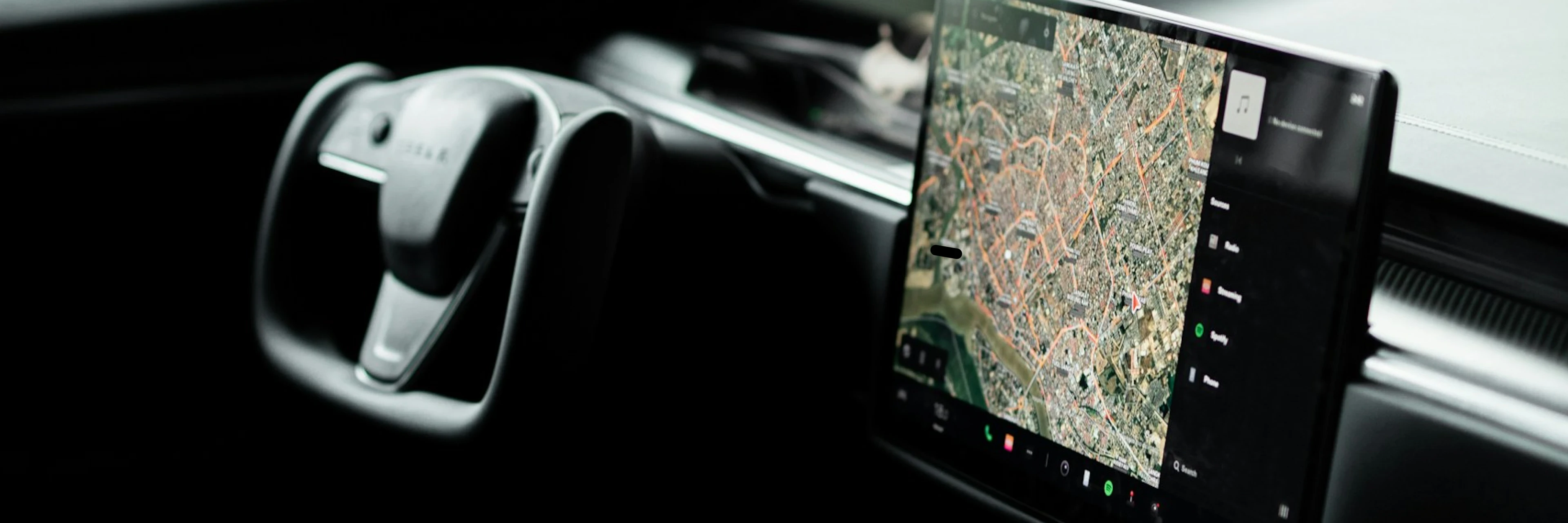
We developed a GenAI-powered voice assistant, enabling Tesla drivers to interact with the platform hands-free.
" transform="translate(2 12)" width="7px"/><path d="M 4.019 0.529 C 4.661 -0.176 5.769 -0.176 6.411 0.529 C 6.736 0.885 7.202 1.078 7.683 1.055 C 8.635 1.011 9.419 1.795 9.375 2.747 C 9.352 3.228 9.545 3.694 9.902 4.019 C 10.606 4.661 10.606 5.769 9.902 6.411 C 9.545 6.736 9.352 7.202 9.375 7.683 C 9.419 8.635 8.635 9.419 7.683 9.375 C 7.202 9.352 6.736 9.545 6.411 9.902 C 5.769 10.606 4.661 10.606 4.019 9.902 C 3.694 9.545 3.228 9.352 2.747 9.375 C 1.795 9.419 1.011 8.635 1.055 7.683 C 1.078 7.202 0.885 6.736 0.529 6.411 C -0.176 5.769 -0.176 4.661 0.529 4.019 C 0.885 3.694 1.078 3.228 1.055 2.747 C 1.011 1.795 1.795 1.011 2.747 1.055 C 3.228 1.078 3.694 0.885 4.019 0.529 Z" fill="transparent" height="10.430050000000001px" id="VwHBMNZeQ" stroke-dasharray="" stroke-linecap="butt" stroke-linejoin="miter" stroke-miterlimit="10" stroke-width="2" stroke="rgb(250, 250, 250)" transform="translate(11.785 11.785)" width="10.430050000000001px"/><path d="M 0 1.091 L 1.091 2.182 L 3.273 0" fill="transparent" height="2.181800000000001px" id="ZMc55zEYG" stroke-dasharray="" stroke-linecap="round" stroke-linejoin="round" stroke-width="2" stroke="rgb(250, 250, 250)" transform="translate(15.364 15.909)" width="3.2727999999999984px"/><path d="M 4 8 C 6.209 8 8 6.209 8 4 C 8 1.791 6.209 0 4 0 C 1.791 0 0 1.791 0 4 C 0 6.209 1.791 8 4 8 Z" fill="transparent" height="8px" id="pxzERnMyB" stroke-dasharray="" stroke-linecap="round" stroke-linejoin="round" stroke-width="2" stroke="rgb(250, 250, 250)" transform="translate(5 4)" width="8px"/></svg>)
Client
Kilowatts Co.
Country
USA
" transform="translate(4 2)" width="18px"/></svg>)
Solution
Agent-based voice AI assistant
CLIENT’S CONTEXT
A mature platform with a safety gap
Our client, Kilowatts Co., developed an infotainment application for Tesla owners. The platform combined several digital services in one ecosystem, from trip support and charging-related services to purchases and payments.
Alongside a wide range of capabilities, the platform required continuous manual interaction through a mobile interface. Drivers had to shift their attention between the road and the application to complete tasks, which increased cognitive load and compromised driver safety. To address this safety issue, the client decided to build a voice-based AI assistant and engaged our team to design and deliver it.
OUR APPROACH
Implementing the solution
We began with a thorough analysis of the client’s existing cloud-based microservice architecture and the services already running inside the Kilowatts ecosystem. The platform already had established back-end flows, external integrations, and a defined service structure, so rebuilding it would have meant spending resources on replacing what already worked instead of solving the actual interaction problem. The right approach was to naturally integrate an AI layer into the existing architecture.
To implement this layer, we developed and integrated a dedicated microservice connecting the Kilowatts back end with OpenAI APIs. This microservice became the technical bridge between natural voice interaction and the platform’s existing execution flows, keeping both layers independent and the overall system stable.
SOLUTION
Agent-based architecture

The AI layer is designed as a multi-agent system. At the core is an orchestrator agent that receives driver requests, handles intent recognition, and routes each request to the appropriate downstream agent.
Each downstream agent owns a specific functional domain—navigation, ordering, payments, and vehicle communication—and interacts with the platform exclusively through a defined set of function calls. This means that agents can trigger actions but have no direct access to underlying services or data stores.
Execution responsibility stays entirely within the existing back-end infrastructure, which processes every action through its established service integrations. This keeps the AI layer controlled while making the system easier to extend with new driver scenarios in the future.
VOICE-ENABLED PLATFORM CAPABILITIES
Order creation
The assistant allows drivers to create orders from nearby cafés, restaurants, and stores by voice. A driver can ask for available options nearby, along the route, or close to the destination. The assistant suggests relevant places, helps review available items, supports product customizations, and guides the driver toward order confirmation.

Navigation to charging stations
A driver can ask for chargers near the current location, along the route, near the next stop, or close to the destination. The assistant can also account for practical preferences such as charging speed or nearby amenities, including cafés, shops, hotels, dog-friendly places, or restrooms.
Route planning and navigation
The assistant allows drivers to create routes by voice and send them to the vehicle’s navigation system. A driver can name a destination, ask for the most suitable route, and confirm the trip without typing or switching between screens. Once confirmed, the route is sent to the Tesla navigation system.

Battery reserve planning
Before mapping the route, the assistant can ask what battery level the driver wants to have upon arrival. The platform then uses this preference when calculating the route and charging stops, helping the driver plan the trip around the desired energy reserve. This is especially important for longer trips, unfamiliar routes, or areas with limited charging infrastructure, where battery planning directly affects the driving experience.
Proactive suggestions
The voice assistant adapts to changing trip conditions and can offer proactive recommendations. It uses the route, destination, battery level, and past preferences to understand when a charging stop, restaurant, store, or another option may be useful during the trip.
RESULT
A safer interaction model without rebuilding the product
Kilowatts gained a voice AI assistant that gives drivers access to core trip services while preserving the platform’s existing back-end logic and integrations. This reduced delivery risk, kept time to market short, and created a scalable foundation for future voice capabilities.
Safety
core services by voice
Speed
AI layer, no rebuild
Scale
new scenarios via agents